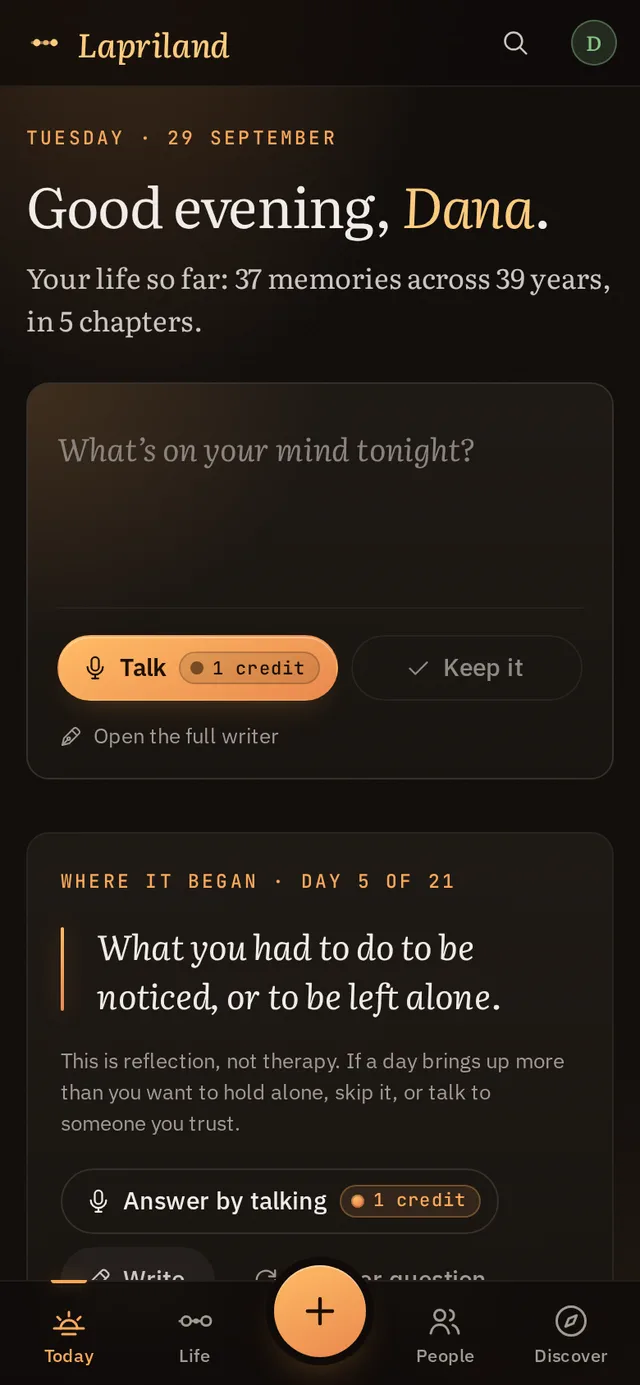
Say it
Tap Talk in your browser, on your phone or your computer, or send a voice note to the Lapriland bot on Telegram. Umms, second thoughts and two languages in one sentence are all fine.
Talk
Talk about last Tuesday, or about a summer you can only place as “when I was about twelve.” Lapriland writes it down in your own words, puts it where it belongs on the timeline of your life, and when you ask, reads your life back to you.
No card needed. Export everything whenever you like.
Already have an account? Sign in
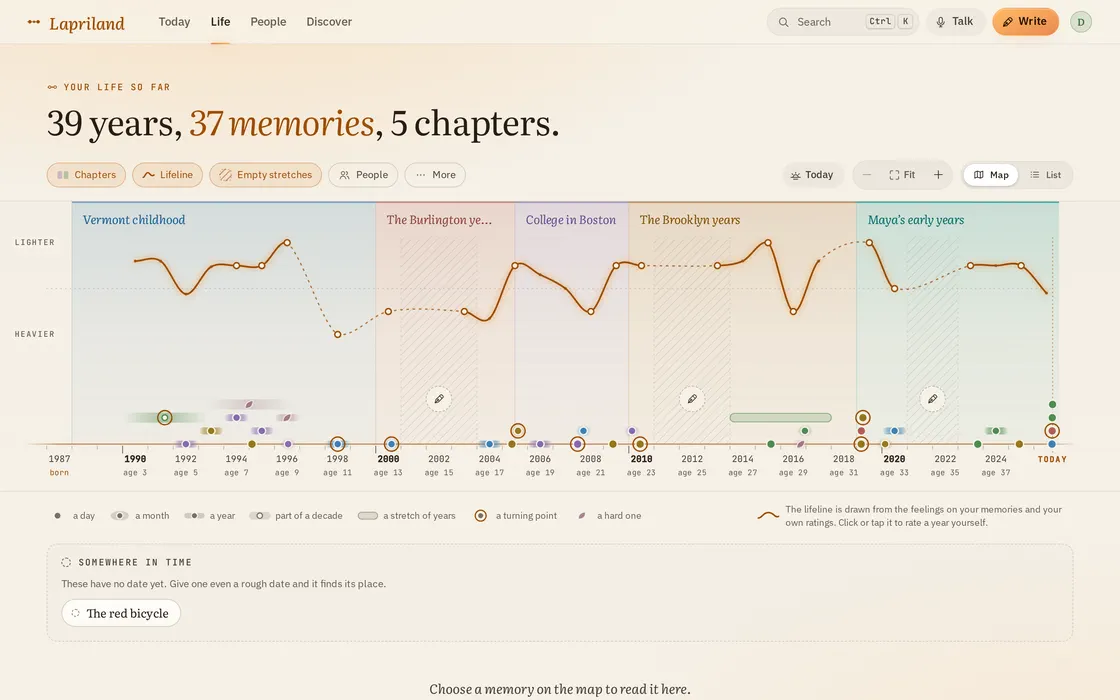
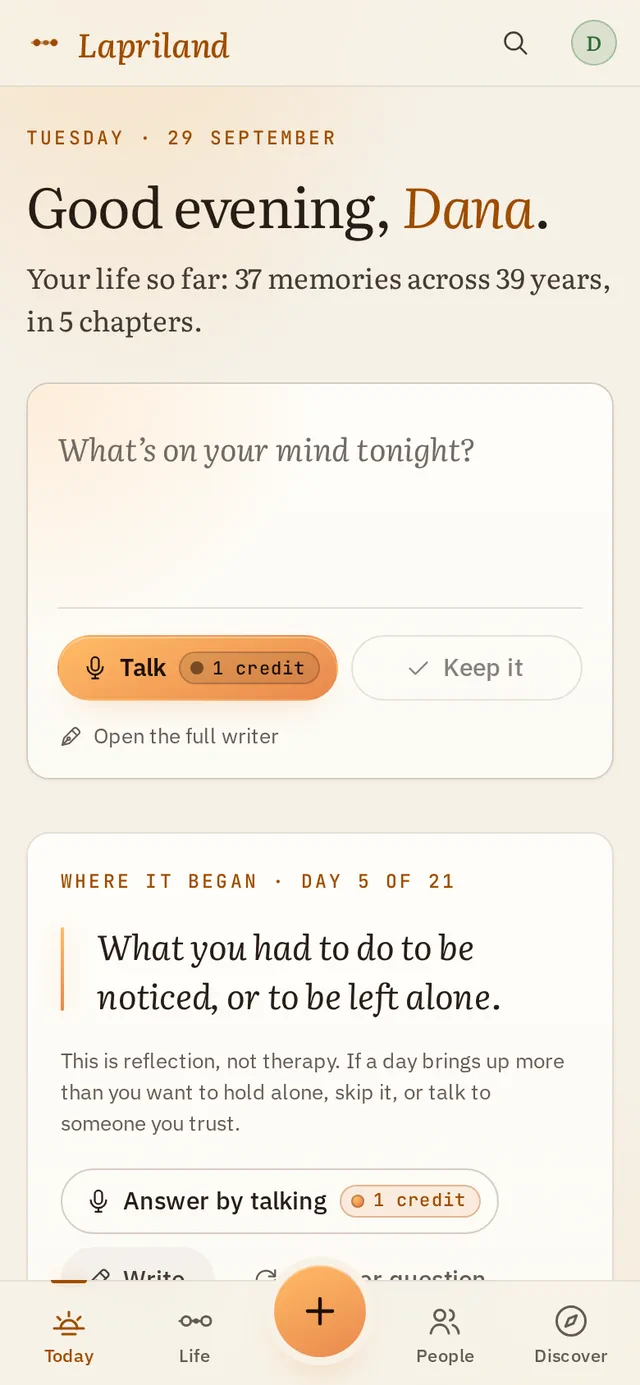
Every screen on this page comes from a sample journal we wrote for someone called Dana. She is made up. The app is real.
Most journals keep today. Lapriland keeps your whole life in order, so a Tuesday evening can be read beside a kitchen from thirty years before.
Dana snaps at her seven-year-old over a spilled cup. Afterwards she sits in the car in the driveway and talks into her phone.
“I did the cup thing again. I sounded exactly like…”
She doesn’t finish the sentence. She doesn’t have to.
She had told her journal about a kitchen, a glass of milk and her father’s voice. She didn’t know the year, so she said “I was about nine,” and it went on her timeline at about 1996.
She marked it as a hard one. Nothing loud happened. It was simply kept, in its place.
I knocked a glass of milk off the table reaching for the salt. It didn’t even break. Dad’s voice went up so fast that the whole kitchen went quiet…
A hard memory, kept quietlyShe asks her journal one question. “Why do I do that?”
The answer comes back in her own words, with the dates she gave them.
Why do I do that?It seems to happen when something small spills and the room gets loud 22 Sep 2026. You have written that it feels exactly like your father in the kitchen, when you were about nine c. 1996.
What did nine-year-old you need in that kitchen?
It didn’t start on Tuesday.
There is another cup. She notices her breath first. She gets the towel and says, “It’s okay, it’s just milk.”
Nobody is fixed by a Tuesday. But something loosens, and the journal keeps the evening it did, threaded to the one before.
Start your own journal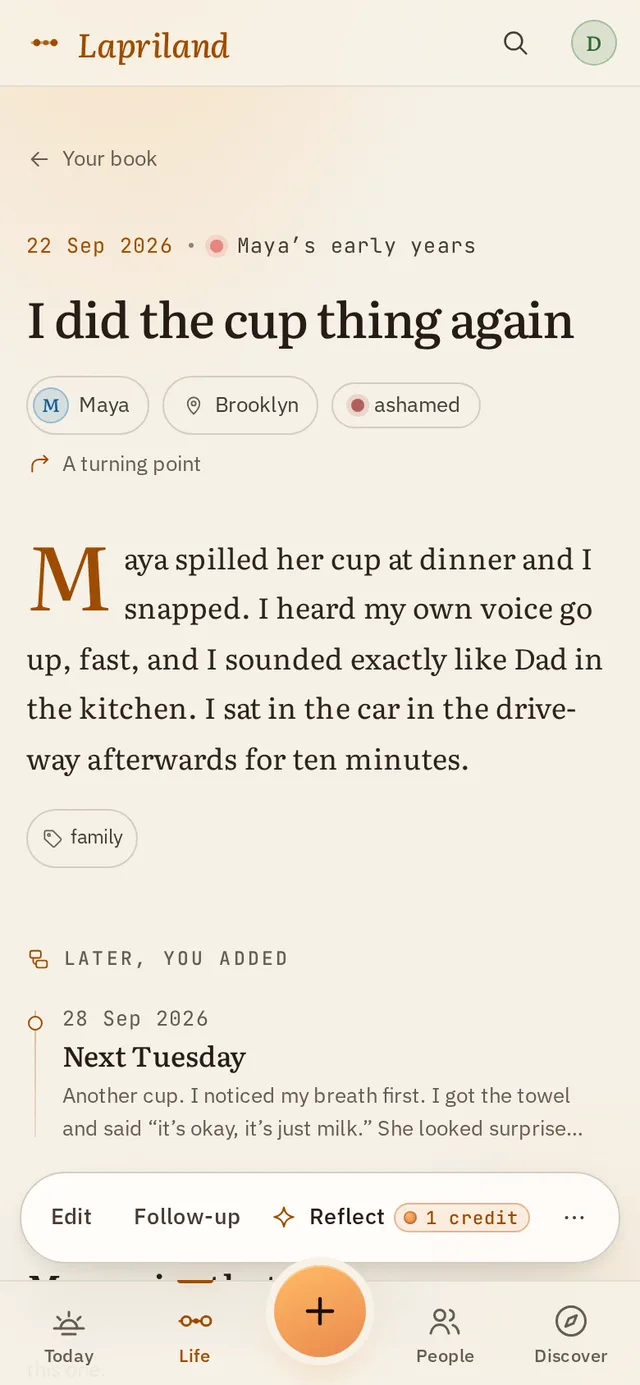
Tap Talk in your browser, on your phone or your computer, or send a voice note to the Lapriland bot on Telegram. Umms, second thoughts and two languages in one sentence are all fine.
You get a title, the people and places in it, a word for the feeling, and a date worked out from what you said. Check it, fix anything in a tap, and keep it.
Ask a question, draw your portrait or open a reflection. Every answer points to the memories it came from, so you can always see where a line came from.
…the promise you made Maya the day she was born 8 Mar 2019.
Type when something happened, the way you would say it. This is the same date reader your journal uses, running right here on the page. Nothing you type leaves it.
One box to talk or type in. A question for tonight if you want one, a letter that is ready to open, and a quiet look at your week. Nothing to keep up and no streak to break.
Every memory on one line, from the year you were born to today, in the chapters you name. Draw a lifeline through the lighter and heavier years, and see the stretches you have not written about yet.

Once there are a few memories, ask for your portrait: a paragraph about who you are, as your memories tell it, with every line tied to a memory you can open. Around it are rooms for your life story, the patterns that repeat, what you value, then and now, and a place to ask anything.

Nonna, Grandma and Rosa are one person. Everyone you mention gets a page with your story together on the timeline, the places you shared, the people around them, and a portrait of them when you want one.

Twelve key scenes from the research on life stories, questions for any evening, six kinds of letters, letters sealed until a date you choose, and short programmes like Where it began: one question a day for three weeks, read back together at the end.

Every memory in order, chapter by chapter, typeset to print or to save as a PDF. Hard memories stay out unless you choose to include them. It is yours on every plan.

Two themes, and a journal that fits your phone. Add it to your home screen and it opens like an app.
Say half a sentence in Italian and the rest in English, and it is kept exactly that way. Or ask for everything in one language.
Add to a memory later. The cup and the next Tuesday stay together.
Seal a letter until a day you choose, from tomorrow to thirty years ahead.
A picture and a sentence, kept as one memory with the people in it.
Pin the song that was playing, and your music page becomes the soundtrack of your years.
Edit or tidy a memory and the version before is saved, so nothing you said is lost.
Search every memory by a word, a name or a place, from the top of any page.
Off unless you turn it on: a question in the evening, this day in past years, or a Sunday look back, on Telegram.
A journal only works if you can say anything in it. So the rules are short, and the privacy policy says them in plain words.
Your words go to the AI only for something you asked for: writing up a voice note, answering a question, drawing a reflection.
Requests go only to AI providers that agree not to keep or train on what they are sent. Your journal is never sold or shared.
One switch on a memory and it is never sent to the AI, not even for a reflection on your whole life.
Your voice is written down, then the recording is deleted. We keep the words, not the audio.
No advertising and no data brokers. The journal is the product, and you pay for it.
Download everything as data, as a readable book and every photo, on every plan. Delete your account from Settings whenever you like.
A life that only keeps the good parts is a highlight reel.
Mark a memory as hard and nothing loud happens. It doesn’t turn red or set off a counter, and it is never brought back to you unasked. It is simply held, in the right place in time.
When you want to, a reflection can look across them and gently say what it notices: where a pattern may have begun, and what it made more or less possible. It says “may” and “might,” and it never tells you what is wrong with you.
This is reflection, not therapy. If things feel heavy, please talk to someone you trust, a doctor, or a crisis line where you live.The free plan is a real journal, not a trial. The AI is paid for in credits, so you only ever pay for what you use.
No card and no countdown.
or $48 a year, which is 4 months free Save $24
More credits on any plan.
Typing a memory, editing it, the life map, people pages and your book never use credits.
No. You can talk to your journal in your browser, on your phone or your computer, and add it to your home screen so it opens like an app. The Telegram bot is there if you like sending voice notes from a chat.
Speak the way you do at home. If that is two languages in one sentence, it stays two languages in one sentence, word for word. If you would rather have everything in one language, that is a setting. The Name Book keeps the same person as one person, whichever language their name was said in.
No. It is a journal that helps you reflect, and it is careful about it. It never diagnoses and never tells you what is wrong with you. If things feel heavy, please talk to someone you trust or to a professional.
A commercial language model, reached through a routing service that sends requests only to providers who agree not to keep or train on them. We may change the model as better and safer ones appear. Your words go out only when you ask for something, only for that request, and memories you keep away from the AI are never sent. The privacy policy says exactly when your words leave the server.
Credits pay for the AI, and only the AI. A voice note written up is 1 credit, and a reflection across your whole life is 3 credits. Typing a memory, the life map, people pages and your book never use any. Free comes with 5 a month and Pro with 300. Packs top you up and last twelve months.
You go back to the free plan and keep everything you wrote. Nothing is deleted, and you can export all of it whenever you like.
Yes, on every plan. One download gives you all your data, a readable book of your life and every photo. You can also print your book or save it as a PDF.
It doesn’t have to be an important one. Pick a place to begin, or just start talking.
No card needed. Everything you write is yours to export whenever you want it.