What is an approximate date, and how do you write one?
An approximate date is your best honest estimate of when something happened, when you don’t know the exact day: “about March 2019”, “c. 2015”, “the early 2000s”.
On a form, it means the same: your best estimate, usually a month and year, written so it is plain that it is approximate. A question like “approximate date of purchase” or “approximate dates of employment” is asking for exactly that.
How to write an approximate date
Write as much as you know, and say that it is an estimate. Each of these is clear:
- A month
- “about March 2019”, or “March 2019 (approx.)”
- A year
- “c. 2015” or “circa 2015”, or “2015 (approx.)”
- A season
- “Spring 2018”
- Part of a decade
- “early 2000s”, “mid 1990s”, “late 1980s”
- A stretch of time
- “2014 to 2016”, or “from about May 2014 to June 2016”
Circa is Latin for “around”, and c. and ca. are its short forms. Each goes before the year and means about then: “c. 2015” is around 2015. Approx., short for approximately, goes after the date, often in brackets.
If the form gives you boxes for a month and a year, put your best estimate in them, and add “approx.” beside them if there is room. With From and To boxes, estimate each end the same way. And if the form says how to show an estimate, do it the form’s way.
Turn what you remember into a date
Type when it was, the way you would say it. The box reads it with the date reader a Lapriland journal uses, and shows you a date you could write on a form.
- Read as
- Type a when
- Date
- Any way you say it
- Age
For your exact age on a given day, or the months you were 30, use the full age and year calculator.
Keep what you just worked out
You have just pieced part of your life back together for a form. Keep it, so next time the dates are already there.
Lapriland is a private journal that takes a date the way you remember it. Say or type a memory with its when, as loose as it is: “when I was about 30”, “the summer of 2018”, “the early 2000s”. Each one goes to its place on your life map, one line from the year you were born to today, drawn to show how sure the date is. The next time a form asks when, you look it up instead of working it out again.
Start your journal, free No card needed. Sign-up is closed in the EU, the EEA and the UK.
Seven kinds of date
An approximate date is also how a life is remembered: as exact as you know, and no more. In a Lapriland journal, every memory has one of these seven kinds of date. You don’t pick from a list: say or type the when as it comes to you, and the journal works out which kind it is.
- A day. “Yesterday”, “last Tuesday”, “14 March 2019”.
- A month. “March 2019”, or a season with its year: “summer 2005”.
- A year. “Back in 2005.”
- An age. “When I was about nine”, “at 25”, “in high school”. The birth year in your profile turns an age into a year, and “as a teenager” lands in the middle of those years, with your words kept beside it.
- Part of a decade. “The early nineties”, “the mid 2000s”, or a whole decade: “the seventies”.
- A stretch of years. “Between 2003 and 2006”, for the things that went on for a while.
- No date at all. “I don’t know” is an answer too. The memory is kept just the same, in a place called Somewhere in time.
“About”, “around” and “roughly” are understood, and they never make a date more exact than you said it. A voice note is dated the same way, from what you said in it: “when I was twelve” stays an age, not a guessed day. Each memory then shows its date the way you would say it: “c. 1996, when you were about 9”, “Early 1990s”, “2014 to 2017”.
How they look on the life map
Every memory with a date sits on the life map, one line from the year you were born to today, and the shape of its mark shows how sure the date is. A day is a single dot, a month a dot with a soft halo, a year or an age a soft bar the width of that year, part of a decade a wider shaded band, and a stretch of years a capsule from the first year to the last.
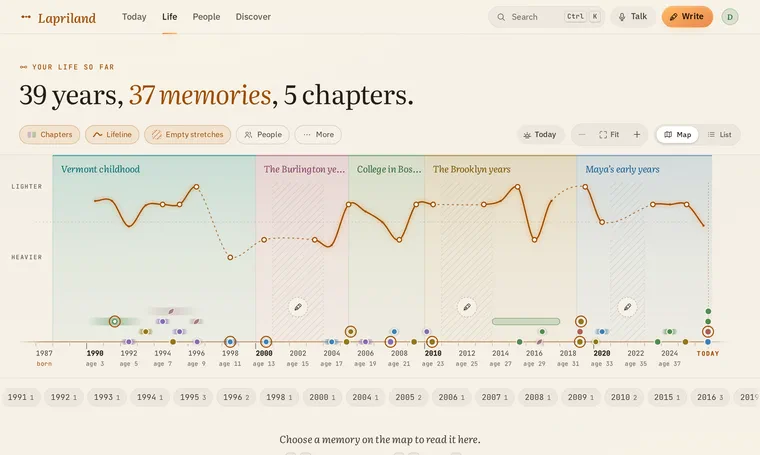
The surest dates sit closest to the line and the looser ones above them, so what you know and what you are guessing show at a glance. Memories with no date wait under the map, in Somewhere in time, until you give them one.
When you find the real date
An approximate date is where a memory sits until you know better, and often you will: a photograph turns up with a year on the back, or a sister remembers which flat it was. Open the memory, choose Edit, and give the When box the new date, as loosely or as exactly as you now know it. Refine, beside it, asks “How sure are you?” if you would rather choose. The memory moves to its new place on the map. On Telegram, every voice note’s reply has a Wrong date button: tap it, say the date in words, and it is fixed, at no cost.
Keep a memory with no date at all, too: often it is the one that matters. Say what you do know, the house, the school, who was there, and keep the doubt in your words. On its own page, Place it in time puts it before or after another memory, so it keeps its place in the order until a date comes back. How to journal about a childhood you can’t date has more ways in.
Some memories come back without a date because they come back in pieces. Keep what you want to keep, and leave the rest for another day. If a memory is more than you want to hold alone, talk to someone you trust.